By
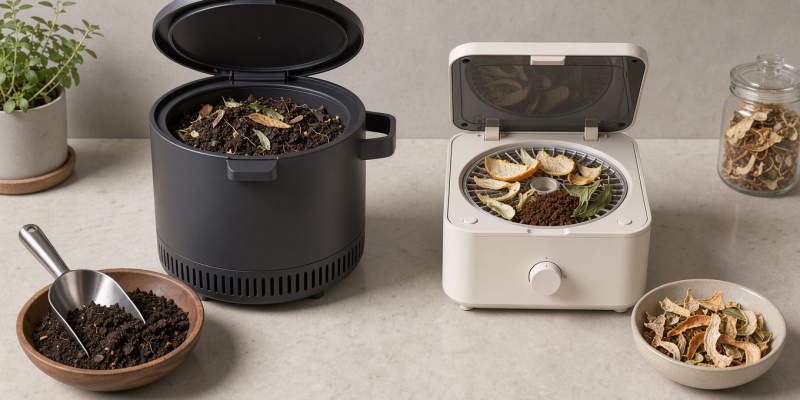
Electric food waste machines are becoming an increasingly popular option for households looking to reduce the amount of rubbish they send to landfill.
Marketed as kitchen composters, electric food recyclers and food waste processors, these appliances can appear quite similar. Most promise to reduce the volume of everyday food scraps and make kitchen waste easier to manage.
However, not every machine uses the same technology, and not every machine produces compost.
Some primarily dry and grind food scraps, while others use microorganisms to biologically break down organic material.
Understanding the difference is important before spending money on a machine that may not deliver the results you’re expecting.
What Is a Food Waste Dehydrator?
A food waste dehydrator typically uses heat, airflow and mechanical grinding to process kitchen scraps.
Its primary function is to remove moisture and reduce the physical size of food waste.
Depending on the model, a processing cycle may involve heating, drying, grinding and cooling the material.
The result is usually a lightweight, dry mixture resembling small food particles or flakes.
Advantages of Food Waste Dehydrators
Dehydrators can make wet food scraps easier to handle and store.
Removing moisture reduces weight and may help manage some of the unpleasant characteristics associated with storing food waste in a kitchen bin.
Many models are compact, making them suitable for households with limited kitchen space.
Does a Food Dehydrator Produce Compost?
Not through dehydration alone.
According to the US Environmental Protection Agency’s composting guidance, drying and grinding food scraps does not produce biologically mature compost.
The resulting material may be suitable for further processing in a composting system, but its appropriate use depends on the contents and treatment method.
Applying large amounts of incompletely decomposed food material directly to plants may cause problems.
What Is a Microbial Food Waste Composter?
A microbial food waste composter uses microorganisms to break down suitable organic material through biological activity.
Rather than relying primarily on drying food scraps, the machine creates conditions intended to support microbial decomposition.
Depending on its design, a microbial composter may regulate temperature, moisture, mixing and airflow.
Microorganisms consume and transform components of the food waste, gradually changing its original composition.
Some machines support continuous operation, allowing households to add suitable food scraps during everyday use instead of waiting for individual processing cycles to finish.
Does Microbial Processing Create Usable Compost?
Microbial decomposition is an essential part of composting, but the quality and maturity of the output still matter.
Finished compost should be sufficiently stable and suitable for its intended application.
The processing time, waste composition and operating conditions influence the characteristics of the resulting material.
Always follow the manufacturer’s instructions regarding curing, mixing ratios and garden applications.
Food Waste Composter vs Dehydrator: Key Differences
Although both technologies can reduce the amount of food waste households need to manage, they achieve this in different ways.
| Feature | Food Waste Dehydrator | Microbial Food Waste Composter |
| Main processing method | Heating, drying and often grinding | Biological decomposition using microorganisms |
| Main purpose | Reduce waste volume and moisture | Break down suitable organic material |
| Typical output | Dried food particles | Biologically processed organic material |
| Microbial activity | Not the primary mechanism | Central to the process |
| Operating cycle | Commonly batch-based | Some models support continuous feeding |
| Additional processing | Often required for compost production | Depends on output maturity and intended use |
| Maintenance | Cleaning and possible filter replacement | Cleaning and maintenance of microbial conditions |
| Best suited to | Volume reduction and easier waste storage | Households wanting biological food waste processing |
Neither technology should be assessed solely by its percentage of weight reduction. Removing water can significantly reduce waste weight without converting the food into compost.
Which Food Waste Machine Is Better for Your Home?
The right machine depends on what you want to achieve.
Choose a Dehydrator If You Mainly Want to Reduce Waste Volume
A compact electric food recycler may be suitable if your priority is making kitchen waste lighter and easier to store.
It may also be useful if you already have access to a suitable composting system that can process the dried output.
For households with limited outdoor space, consider how the resulting material will be handled before buying.
Choose a Microbial Composter If You Want Biological Decomposition
A microbial food waste composter may be more appropriate if you want a machine that actively breaks down suitable organic waste.
This can be particularly useful for households producing food scraps regularly and wanting to recover organic material for garden applications.
However, you still need to follow the machine’s feeding restrictions, daily processing capacity and output instructions.
Consider Conventional Composting Too
A traditional compost bin or worm farm may be a practical option if you have suitable outdoor space.
Neither requires the same electrical equipment as an automated food waste machine.
However, conventional composting requires appropriate materials, moisture management and ongoing attention.
An electric system may offer greater convenience in some households, but it is not automatically the most economical or environmentally suitable option for everyone.
Six Things to Check Before Buying a Kitchen Composter
1. Understand What the Machine Actually Does
Find out whether it primarily dries food waste, uses microbial decomposition or combines several processing methods.
Marketing terms such as ‘food recycler’ and ‘electric composter’ do not establish how a machine works.
2. Check the Daily Processing Capacity
Consider how much food waste your household generates each day.
A larger chamber does not necessarily mean the machine can process its entire contents within 24 hours.
Compare the manufacturer’s recommended daily input capacity with your actual requirements.
3. Review Accepted Food Types
Some machines cannot process large bones, hard shells, fibrous materials or excessive quantities of oil and liquid.
Check the operating manual rather than assuming all organic kitchen waste is suitable.
4. Calculate Electricity and Maintenance Costs
Compare expected energy consumption, operating hours, replacement filters and other consumables.
A machine with a lower purchase price may involve higher ongoing maintenance costs.
5. Understand Odour Management
Ask how the machine manages odours and whether filters or other components need regular maintenance.
Poor feeding practices or excessive moisture can affect performance even when a machine includes an odour-control system.
6. Find Out How the Output Can Be Used
Ask whether the resulting material requires further composting, curing or mixing with soil.
If your objective is producing material for your garden, this is one of the most important questions to resolve before purchasing.
HASS: An Example of Microbial Food Waste Processing
One example of a microbial system is the HFC-250M from HASS Food Composters.
According to HASS, this household model uses microorganisms and has a recommended processing capacity of approximately one to two kilograms of suitable food waste per day.
The company states that the initial microbial culture is added once and can reproduce during normal operation.
Its odour-management system includes UV-C, ozone and metal oxidation components.
These technologies serve a different purpose from the microorganisms themselves: they help manage emissions and odours rather than performing the biological decomposition.
HASS also recommends draining excess liquid from food scraps and removing unsuitable hard materials, including bones and shells, before feeding the household machine.
As with any microbial system, users should avoid exceeding its recommended daily input and follow the manufacturer’s guidelines for handling the processed material.
Australian buyers should confirm local product availability, electrical compliance, warranty coverage and servicing arrangements.
The Bottom Line
Food waste dehydrators and microbial composters can both play a useful role in household waste management, but they are not interchangeable technologies.
A dehydrator may be suitable if your priority is reducing waste volume and simplifying storage.
A microbial composter may better suit households looking for biological decomposition and recovering organic material.
Before buying, understand how the machine works, how much waste it can process and what you can realistically do with its output.
Choosing the appropriate technology for your household is more important than simply buying a machine labelled as a kitchen composter.